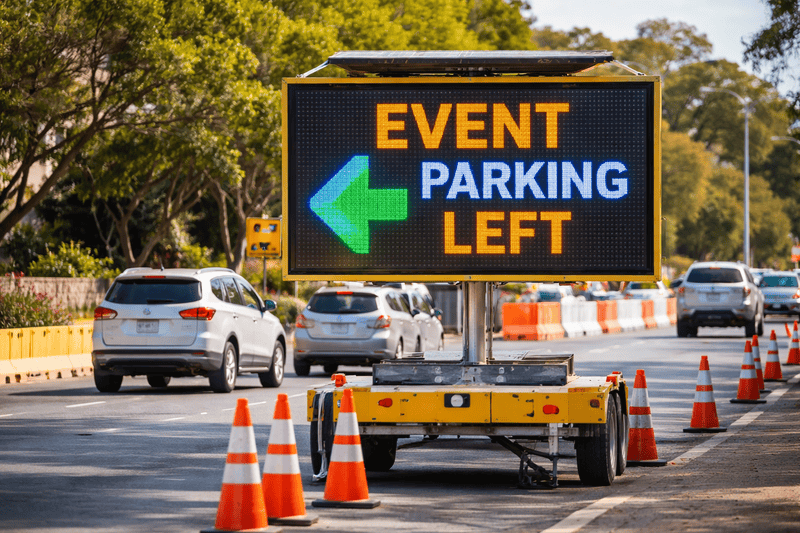
Across Australia, temporary traffic control and event communication rely on clarity, speed, and adaptability. Static signage has long been part of this equation, but the increasing complexity of road networks, construction schedules, and public events has driven demand for smarter solutions. Colour VMS Signs have emerged as a practical response to this shift, offering councils and businesses a flexible way to communicate real-time information where and when it matters most.
Unlike fixed signs, colour variable message signs mounted on trailers allow messages to be deployed, updated, and removed as conditions change. This mobility has made them particularly useful for roadworks, infrastructure upgrades, and planned events where traffic conditions may vary from day to day.
Understanding what Colour VMS Signs are designed to do
Colour VMS Signs use full-colour LED displays to deliver highly visible messages to motorists, pedestrians, and site users. These signs are typically trailer-mounted and hired for temporary use, rather than installed permanently. The emphasis is on clear communication rather than advertising or branding.
Messages may include traffic warnings, lane closures, speed advisories, detour information, or event-related instructions. Because the content is digital, it may be updated quickly to reflect changing site conditions or emerging issues.
It is important to note that providers such as Trailer Signs focus on the hire of trailer-mounted VMS signage, not the manufacture of trailers and not the hire of trailers for vinyl wraps. The core service is about message delivery and traffic communication, not mobile advertising platforms.
Why councils and businesses rely on hired VMS signage
Hiring Colour VMS Signs offers flexibility that permanent signage cannot match. Councils managing rotating roadworks schedules or businesses coordinating short-term infrastructure projects often need signage only for limited periods. Ownership may not be practical or cost-effective in these scenarios.
Hiring also allows access to compliant, maintained equipment without the long-term responsibilities associated with storage, servicing, or upgrades. This approach suits organisations that need reliable signage deployed efficiently across multiple sites throughout the year.
Many project managers review options such as High-Quality Colour VMS Boards for Hire when planning temporary traffic or event management strategies.
The importance of visibility and message clarity
One of the defining features of Colour VMS Signs is their ability to attract attention without overwhelming road users. Colour adds contrast and emphasis, helping key messages stand out against complex visual environments such as busy intersections or construction zones.
When used appropriately, colour supports comprehension rather than distraction. For example, highlighting warnings or directional arrows may help motorists process information more quickly, which may contribute to safer decision-making.
This level of clarity is particularly relevant in environments where drivers may already be navigating unfamiliar conditions, such as detours or temporary lane arrangements.
Supporting safer roadworks and infrastructure projects
Roadworks remain one of the most common applications for Colour VMS Signs. Temporary changes to traffic flow require clear, timely communication to reduce confusion and minimise risk.
Trailer-mounted VMS signage allows messages to be positioned strategically before, during, and after work zones. As conditions evolve, messages may be updated to reflect new stages of work or changing access points.
Councils and contractors often turn to Professional VMS Hire for Roadworks and Signage Solutions when coordinating these environments, as hired signage supports consistency across multiple sites without long-term commitment.
Event management and temporary crowd communication
Beyond roadworks, Colour VMS Signs play an increasing role in event management. Large gatherings such as festivals, sporting events, or community celebrations often involve temporary traffic changes and pedestrian flow adjustments.
Digital signage allows organisers to direct attendees efficiently, communicate start or finish times, and respond to unexpected issues such as weather changes or congestion. Because the signs are hired and temporary, they suit events that run for days or weeks rather than months.
This adaptability supports smoother logistics without leaving permanent infrastructure behind once the event concludes.
Compliance and responsibility in signage deployment
Using Colour VMS Signs responsibly involves understanding regulatory expectations and best-practice placement. Messages should be concise, legible, and relevant to the road environment.
Organisations responsible for deploying signage may benefit from reviewing broader SEO and traffic communication guidance, such as content found in technical signage planning resources, which discuss clarity and audience understanding in information delivery.
Although digital signage technology continues to evolve, the fundamentals of clear communication remain constant.
The distinction between signage hire and advertising trailers
It is worth reinforcing that Colour VMS Sign hire differs significantly from mobile advertising or vinyl-wrapped trailer hire. Trailer-mounted VMS units are purpose-built for information delivery rather than brand promotion.
Providers such as trailersigns.com.au do not manufacture trailers and do not supply trailers for vinyl wrap advertising. Their role centres on hiring compliant signage equipment that supports traffic management, site safety, and event coordination.
This distinction helps ensure that VMS signage remains focused on public communication rather than commercial display.
Strategic placement and message timing
The effectiveness of Colour VMS Signs depends as much on placement and timing as on the technology itself. Signs positioned too close to decision points may reduce reaction time, while poorly timed messages may confuse rather than assist.
Project planners often integrate VMS signage into broader traffic management plans, considering sightlines, speed environments, and message sequencing. The goal is to provide information early enough for drivers to respond calmly and safely.
Insights into structured communication strategies, such as those outlined in digital communication frameworks, highlight the importance of timing and relevance in information delivery.
Flexibility without long-term infrastructure
One of the strongest advantages of hiring Colour VMS Signs is the ability to scale deployment up or down as needed. A council managing multiple concurrent projects may adjust the number of signs in use week by week without investing in permanent assets.
Similarly, businesses undertaking short-term works may access professional signage only for the duration of their project. This flexibility supports efficient resource use and reduces unnecessary overheads.
Many organisations explore options such as Reliable Colour VMS Boards for Event Management when planning projects that require temporary but effective communication tools.
Looking ahead: the ongoing role of VMS signage
As urban environments become more dynamic, the demand for adaptable communication tools is likely to remain strong. Colour VMS Signs offer a practical balance between visibility, flexibility, and responsibility when used appropriately.
Rather than replacing traditional signage entirely, they complement existing systems by filling gaps where temporary, real-time messaging is required. Their value lies not in novelty, but in their ability to respond to changing conditions with minimal disruption.
For councils and businesses alike, hiring trailer-mounted Colour VMS Signs may continue to be a sensible way to manage information flow without committing to permanent infrastructure.